History of Jodhpur
History of Jodhpur
The realm of Jodhpur fell under the dominion of the Rathores, a powerful lineage governing vast stretches of Marwar in the western reaches of Rajasthan, encompassing even the arid principality of Bikaner. This noble clan traces its ancestry to none other than Rama, the revered protagonist of the ancient Hindu epic, Ramayana, and, in turn, harks back to the radiant deity Surya. It is thus no wonder that the Rathores proudly proclaim themselves as the Suryavanshi, or the esteemed progeny of the sun. In more recent annals, historical records mark the first Rathore potentate as Nayan Pal, whose ascendancy commenced in 470 A.D. with the establishment of his kingdom in Kannauj, a proximal region to the present-day city of Kanpur in the northern state of Uttar Pradesh. There, the dynasty thrived for a considerable period until the twilight of the 12th century began casting a distinctly Islamic pall over much of northern India. It was during this tempestuous era that the Afghan ruler Mohammad Ghori annexed Kannauj in 1192, precipitating the flight of the Rathore monarch, Raja Jai Chand, who embarked on his escape, clutching the cherished Rathore panchranga, the resplendent flag adorned with five vibrant hues. Alas, disheartened by the shattering defeat, he met his tragic demise by drowning while traversing the sacred waters of the Ganges.
Following a period of peripatetic sojourns throughout the lands of Gujarat, as eloquently portrayed in James Tod's magnum opus, the Annals and Antiquities of Rajasthan, the indomitable Rathores eventually found solace in Pali, a locale situated in close proximity to Jodhpur. It was here that Rao Siyaji, the worthy successor of Jai Chand, devised a shrewd strategy to assert dominion over Marwar by means of advantageous matrimonial unions. With this astute approach, he espoused wedlock and fathered three sons, who in turn ushered forth a prodigious line of eight grandsons. This fecund lineage burgeoned in strength and numbers until, in the year 1453, Chonda, a descendant of the venerable Siyaji, assembled an imposing force of gallant warriors mighty enough to seize Mandore, the resplendent capital of Marwar. There, amidst the lofty grandeur of this conquest, Chonda entwined his fate with that of the royal lineage, for he, in a true testament to his prowess, took the princess as his esteemed consort and sired no less than fourteen illustrious progeny, thereby solidifying the Rathore stronghold within the realm of Marwar. Alas, the Rajput domain was not impervious to the unrelenting scourge of inter-familial strife, a propensity well-known and deservedly attributed to their distinguished lineage. In this instance, it was the matrimonial alliance between Chonda's daughter, the illustrious Hansa, and Lakha Rana of Mewar that infused discord between these two noble principalities. The tragic consequences of this turbulence culminated in the untimely demise of Chonda, a fate described by one chronicler of the Rathores as an ignoble demise at the hands of one thousand valiant Rajputs on the battlefield of Nagore.
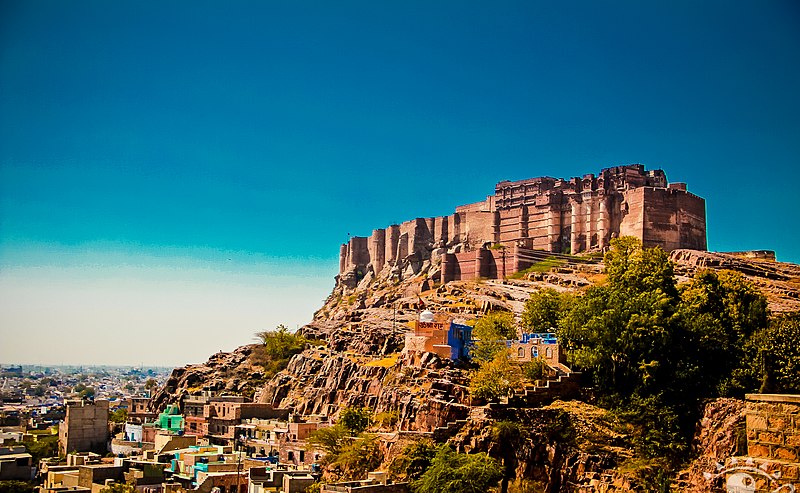
The Mehrangarh Fort
In due course, Rao Jodha, whose son, Rao Bika, would later establish the illustrious city of Bikaner, made the decision to relocate to a safer haven, departing from the domain of Mandore and founding what would become known as Jodhpur in the year 1459. Once again, mirroring the birth of Jaisalmer, it was the guidance of a sage that directed Jodha to establish his settlement upon a weathered peak, aptly named the birds nest, now renowned as Jodhpur. Atop this lofty precipice, Jodha erected his bastion of strength, the formidable Chintamani fortress, which would later be christened as Mehrangarh. For thirty years, Jodha resided in his newly founded capital, and as he drew his final breath upon his deathbed, he must have exuded a tranquil sense of fulfillment, for he and his progeny then reigned supreme over a vast expanse of territory encompassing a staggering eighty thousand square miles. Such triumph stood in stark contrast to the destitution his ancestral line endured centuries prior, when the relentless onslaught of Ghori expelled them from the desolate clutches of Kannauj. Following Jodha's reign, Surajmal ascended to the throne and governed Jodhpur for a considerable score of seven years. It was during his tenure that Jodhpur experienced its inaugural altercation with the imperial forces of Delhi, marking an ephemeral moment of conflict between these esteemed realms.
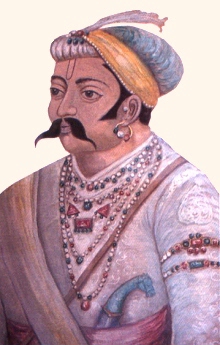
Rao Jodha
In the year 1516, during the dominion of Sikandar Lodi, a horde of Pathans perpetrated a brazen act by abducting one hundred and forty noble Rajput women amidst the sacred observance of the Hindu festival of Teej. This audacious affront incited an indignant Surajmal to take upon himself the solemn duty of restoring Rajput honor. With unwavering resolve, he waged a relentless campaign against the "northern barbarians," triumphing in his mission albeit at the ultimate cost of his very own life. His rightful heir, Rao Ganga Singh, ascended the throne and governed with distinction for the subsequent sixteen years. This noble ruler was an integral member of the final confederacy formed by the Rajputs in their valiant pursuit of national independence. As the illustrious Mughal emperor, Babur, surged triumphantly across the Indus, culminating in his decisive victory over Ibrahim Lodi in the momentous first battle of Panipat in 1526, the Rajputs rallied together in a unified front, emphatically seeking to expunge the foreign invader. Ganga Singh, alongside the valiant Rana Sanga of Mewar, engaged Babur in a fateful clash known as the battle of Khanua in 1528. However, fate cast its darkened die, and the Rajputs were ultimately overpowered, paving the way for the indomitable Mughal dominance that would endure for the ensuing two centuries in the realm of India.
Nevertheless, Babur, while traversing the parched lands of Marwar, discovered no allure tempting enough to divert his attention. Jodhpur, resolute in its autonomy, managed to preserve its distinguished independence. In truth, under the astute leadership of Raja Maldeo, Jodhpur not only fortified its own realms but also significantly expanded its sphere of influence in the latter half of the 16th century. Maldeo skillfully seized control of Nagore and Ajmer, and furthermore, he artfully dispossessed the descendants of Bika, the illustrious founder of Bikaner, from their lofty position of supreme power. Meanwhile, Sher Shah Suri, the formidable Afghan ruler, had ousted the Mughal emperor Humayun from the illustrious throne of Delhi, prompting Humayun to flee to the welcoming refuge of Marwar. However, to his dismay, Maldeo extended no warm embrace, instead bestowing upon the fallen emperor a cold and aloof reception. Despite Maldeo's inhospitality, he found no advantage gained from this deliberate coolness. Driven by his inherent sense of insecurity, Sher Shah resolved to march upon Marwar with an imposing force numbering eighty thousand valiant warriors. Yet, fate would bear witness to the Rajput army, numbering fifty thousand strong, who stood resolute and steadfast. However, owing to the deeply ingrained weakness of Rajput disunity and feuding, the Delhi Sultan seized a narrow victory. Yet, even the Sultan himself, enlightened by hindsight, acknowledged that this was an outcome that nearly sacrificed the very empire of Hindustan for the sake of a meager handful of barley.
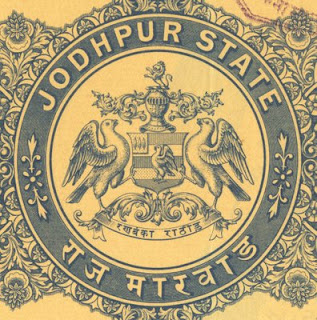
Ranbanka Rathore
It proves intriguing that the Jodhpur coat of arms, in addition to its depiction of the sacred kite of Goddess Durga and the resounding Rathore war cry, "Ranbanka Rathore" (signifying the invincibility of the Rathores in battle), also elegantly includes a handful of barley. This emblematic portrayal carries profound significance, evoking the famous words of Sher Shah. Maldeo, it seemed, was destined to outlast the Sher Shahi dynasty. However, destiny had other plans, as Humayun, having returned from exile, successfully reclaimed his kingdom. Following Humayun's demise in the year 1556, the mantle of Mughal rulership was assumed by the youthful Akbar, a lad of merely thirteen years, destined to emerge as one of the most illustrious monarchs in the annals of Indian history.
Akbar bore a palpable grudge, for the recalcitrance of Jodhpur during his formative years had consigned him to the distant solitude of Amarkot, rather than the opulent comforts of Delhi. In 1561, with a steely resolve, he launched an incursion into Marwar, wresting control of both Jodhpur and the formidable Nagore fort. These two citadels were subsequently entrusted to Rai Singh of Bikaner, who had asserted his independence from Jodhpur's dominion.
Maldeo, compelled to swallow his pride, sought to curry favour with Akbar by dispatching lavish tributes through the intermediary of his second son, Chandra Sen. However, despite the artful stratagems employed by Chandra Sen, they proved ineffectual in swaying Akbar's resolute disposition. In due course, it was his elder sibling, Udai Singh, who skillfully ingratiated himself with the emperor, achieving the unattainable.
The most grievous affront, however, arrived when Maldeo was compelled to render homage to his elder son, Udai Singh, who had been appointed by Akbar. This marked the definitive denouement of Jodhpur's autonomy, as it became an obedient vassal state under the aegis of the Mughal Empire.
The entwining of bonds between Jodhpur and the imperial court was further fortified through the auspicious union of Jodha Bai, sister of Udai Singh, with the esteemed Mughal sovereign, Akbar. As a testament to this matrimonial alliance, Akbar graciously relinquished all territorial acquisitions he had procured from Marwar, save for Ajmer.
In the ensuing epochs, Jodhpur emerged as a stalwart ally in the many grandiose campaigns undertaken by Akbar. Sur Singh, who succeeded Udai, lent his martial prowess to the imperial cause, serving valiantly amongst the ranks of the Mughal forces in the Lahore theatre. His instrumental role in the subjugation of Gujarat and significant swathes of the Deccan for Akbar stands as a testament to his unwavering commitment.
Subsequently, the mantle of leadership passed to Raja Gaj Singh, progeny and heir to Sur Singh, who played a pivotal role in quelling the uprising led by Prince Khurram, destined to ascend the imperial throne as Shah Jahan. In recognition of this exceptional loyalty, it is chronicled that Jahangir, his father, expressed his delight by not only clasping the hand of the Rathore prince but bestowing upon it a kiss—a gesture of profound rarity within the annals of Mughal emperors.
The proximity of Jodhpur to the illustrious Mughal court engendered a fertile ground for the flourishing of art, culture, and burgeoning trade and commerce. This era of relative tranquility ushered in a period of opulence and cultural efflorescence.
However, the harmonious relationship between the Mughals and Jodhpur took a somber turn during the reign of Jaswant Singh. In the tumultuous year of 1658, during the bitter contest for succession amongst the progeny of Shah Jahan, Jaswant Singh aligned himself with the ill-fated prince, Dara. His vehement aversion towards Aurangzeb impelled him down this treacherous path. Despite Jaswant's valiant command of the opposing army at Fatehbad, where he faced Aurangzeb, a sense of reconciliation with the Mughal rule never truly materialized.
For a span of twenty-five years, Jaswant Singh remained a vexatious thorn in the side of the Mughal emperor, until Aurangzeb, in an act of decree, dispatched him to Kabul for a fateful encounter with the Afghans—a mission from which he would never return. Entrusting Jodhpur into the hands of his son Prithvi, it was not long before Aurangzeb extinguished the Rathore lineage, through the sinister means of a poisoned robe.
The venerable James Tod, in his sagacious reflection upon Jaswant Singh, remarked that, had the noble lord's abilities matched the magnitude of his power, strength, and courage, he might well have conspired with the numerous adversaries of Aurangzeb to depose the emperor from his lofty throne.
An exemplification of Rajput pride in their indomitable valor is vividly discernible in the actions of Jaswant's queen following his strategic withdrawal subsequent to the battle of Fatehbad. Notwithstanding that he returned victorious, bearing his shield, and thereby vindicating his honor, she, in her steadfast loyalty, firmly denied her fugitive lord ingress through the city's gates. Although ultimately, the ardor of wifely love compelled her to relent, this incident poignantly encapsulated the Rajput ethos, wherein a glorious demise was preferred over a dishonorable retreat.
Jaswant Singh, anointed as the sovereign of Jodhpur through an unusual and intriguing series of events, ascended the throne in a manner quite unorthodox. His father, Gaj Singh, had once bestowed upon his paramour, Angoori Bai, a pair of resplendent pearl-encrusted shoes as a token of his fervent supplication. In reciprocation, Angoori Bai, through her persuasive charms, convinced Gaj Singh to designate Jaswant as the heir apparent, thereby superseding his elder brother, Amar Singh, the legitimate inheritor of the throne. This act exemplified the quintessential notion of reciprocity, where favors were exchanged, and Angoori Bai, in effect, may be deemed as having irrevocably altered the course of 17th-century Jodhpur's history by facilitating Jaswant's ascent to the throne of Jodhpur.
Meanwhile, the religious zealotry that had taken root within Aurangzeb had dire consequences, for it estranged the Rajputs, whom Akbar had so assiduously endeavored to cultivate. In the year 1679, following the imposition of the odious jaziya, a religious tax exacted upon the Hindu populace, Aurangzeb harbored the intent of eliminating Jaswant's infant heir, Ajit Singh, upon Jaswant's demise in 1681. Yet, this nefarious scheme was thwarted by the valiant Rajput hero, Durga Das, who clandestinely spirited the posthumous child out of the confines of Marwar concealed amidst a trove of delectable sweetmeats.
In response to this perceived affront, an incensed Aurangzeb vented his fury by sacking Jodhpur, desecrating numerous sacred Hindu shrines, and demanding the conversion of the entire Rajput lineage to Islam. The emperor's draconian edicts rendered the entire Rajput clan as implacable adversaries of the Mughals, with their determination steadily simmering beneath the surface, awaiting the propitious moment to cast off the imperialist yoke imposed upon them.
The opportune hour materialized with the demise of Aurangzeb in 1707, at the venerable age of eighty-nine. His successor, Bahadur Shah, assumed the imperial throne at the age of sixty-three, swiftly earning the epithet of "Shahi Bekhabar," denoting his heedlessness toward matters of state governance.
For Ajit Singh, who had since come of age, and with the invaluable support of Durga Das, the time had come to seize his birthright - the illustrious gaddi, or throne, of Jodhpur. Together, they forged a triumvirate alliance with Udaipur and Jaipur, embarking upon a quest to reclaim what was rightfully his.
In the annals of Jodhpur's storied history, Ajit Singh emerged as an even more illustrious sovereign than his father, standing as one of the most distinguished princes ever to ascend the revered throne. He inherited his father's abhorrence for the very mention of the Muslim faith, an inclination nurtured by his birth amidst the frigid climes of Kabul and the profound loss of his parents. Furthermore, he inherited his father's indomitable valor, a trait that he manifested at a tender age of eleven when he embarked on a diplomatic mission to his adversary's capital, displaying a grace befitting only a Rajput.
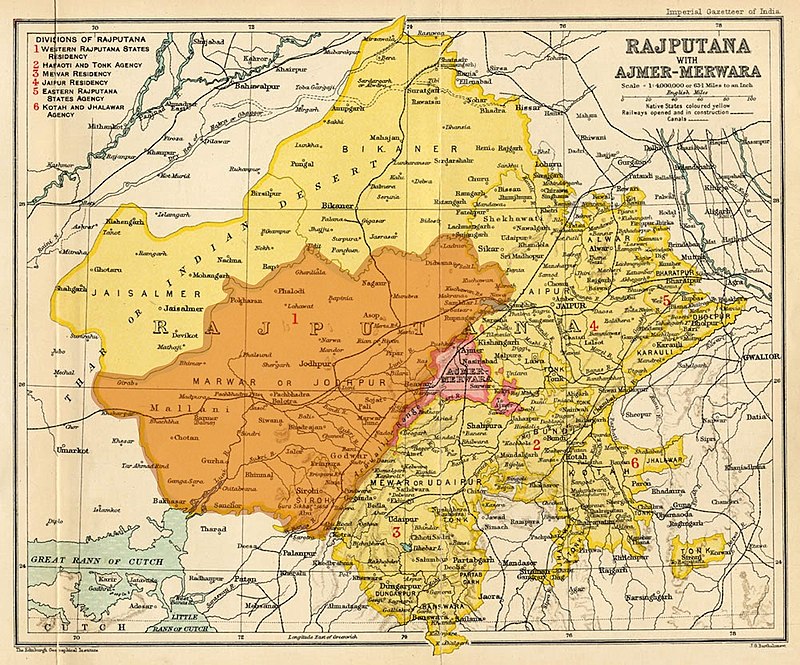
Rajputana (Yellow) Marwar (Orange)
In tandem with Jai Singh of Jaipur and Amar Singh of Mewar, Ajit Singh played an instrumental role in expelling the Mughal dominion not only from Jodhpur but also from the hallowed precincts of Amber. His resentment towards the Mughals intensified when circumstances compelled him to bestow one of his daughters in marriage upon the Mughal emperor, Farrukhsiyyar. However, this seemingly onerous arrangement yielded the viceroyalty of Gujarat as a reward, and he astutely wielded his influence to secure the revocation of the detested jaziya, thereby earning the enduring gratitude of the Hindu populace.
Subsequently, he forged a covenant with the Sayyid brothers within the labyrinthine corridors of the Mughal court, aiming to depose the incumbent emperor, Farrukhsiyyar—an endeavor they executed with meticulous success in the year 1719. This event serves as a poignant testament to the lamentable degeneration of the Mughal dynasty in the post-Aurangzeb era, for it is a sobering fact that no champion from within their ranks extended succor to their beleaguered emperor. Farrukhsiyyar thus stands as the sole Mughal monarch to have met his demise through the hand of an assassin.
In turn, the Sayyid brothers themselves met a grisly end, falling victim to the treacherous intrigues that held dominion within the hallowed precincts of the imperial court, as the Mughal dynasty continued its lamentable descent into corruption and debauchery.
Ajit, cognizant of the vice-ridden nature of the Mughal court, remained resolute in his determination to wrest Ajmer from their grasp. This he achieved through the bold act of slaying the king's appointed governor, thereby ascending to the throne of Ajmer. Under his enlightened rule, where once the Koran had held sway, the resonant verses of the Puran, a collection of eighteen sacred Hindu texts recounting legends, now echoed. Ajit struck his own coinage, instituted his own systems of weights and measures, and established independent courts of justice. His renown reverberated across distant lands, reaching even the far reaches of Persia and Mecca, where it was believed that he had elevated the prominence of his own faith. The rites of the Koran were proscribed across the expanse of Marwar, marking a transformative epoch under the reign of Ajit.
Ultimately, the illustrious life of the great Ajit met a most nefarious end – he fell victim to the foul act of matricide, perpetrated by none other than his own son, Abhay Singh. Astonishingly, it was Abhay Singh who, by the decree of the Mughal emperor Muhammad Shah himself, ascended to the throne in the wake of Ajit's tragic demise.
With the passing of Ajit, the radiant zenith of Jodhpur's history receded into the annals of time, making way for a century fraught with myriad trials and tribulations. Abhay Singh, endowed with scant inclination for revelries, swiftly immersed himself in the arduous task of consolidating his dominion. He endowed the principality of Nagaur upon his sibling, Bukhta, and assumed the mantle of viceroy over Ajmer, where he strategically placed his trusted officers.
However, Nagaur's confines proved too constricting for Bukhta, whose talents outstripped the modest dominion. Moreover, Abhay, in his waning years, succumbed to the allure of opium, a vice that rendered him increasingly paranoid about his brother's influence. The fraternal discord reached its acme when Abhay callously declined to aid Bukhta in his audacious assault upon the kingdom of Amber.
It stands as a testament to the intricate tapestry of Rajput character that they remained conspicuously fragmented, even when presented with the opportune moment to overthrow the Mughals. Their internecine conflicts exacted a heavy toll, ultimately costing them the coveted seat of the Delhi Durbar.
This epoch transpired during the reign of Muhammad Shah, who, due to his proclivity for wine and the fairer sex, earned the epithet of "Rangila," denoting a man of vibrant and indulgent inclinations. In the year 1739, the formidable Persian sovereign, Nadir Shah, laid siege to Delhi, pillaging its opulent treasures and departing with, among other prized possessions, the resplendent Peacock Throne of Shah Jahan. Alas, despite the debauchery that plagued the Mughal dynasty, Rajputana found itself regrettably paralyzed by the despondency afflicting its princely ranks.
In a cruel twist of fate, it was the assassination of Ajit Singh that poignantly underscored a profound moral verity: that at each stage of human civilization, the consequences of transgression shall inevitably exact their just retribution. Following the demise of Ajit Singh, the mantle of Jodhpur's rulership passed to Ram Singh, son of Abhay. Yet, the auspicious coronation was bereft of the presence of his uncle, Bukhta, casting an ominous portent over the days to come.
Ram Singh, imbued with the same fiery temperament that had marked his predecessors, soon found himself on a collision course with his uncle, Bukhta. Their ensuing confrontation was nothing short of a grisly conflict, resulting in the decimation of Ram Singh's forces and compelling the Jodhpur sovereign to flee in disarray. Bukhta, seizing the reins of power, anointed himself as the ruler of the desert city. Bolstered by the support of other clans within Marwar, he harbored a sense of security against the machinations of his nephew.
Nonetheless, it was the insidious venom that achieved what the blade had failed to enact. The nefarious task of eliminating the adversary of her nephew, Ram Singh, was entrusted to Madhu Singh, Queen of Amber. With a sinister finesse, she presented Bukhta with a robe clandestinely imbued with poison, ultimately sealing his demise in the year 1753.
Meanwhile, the Marathas, rising with relentless momentum, were poised to supplant the Mughals as the paramount power in the Indian subcontinent. In concert with the Prince of Amber, Ram Singh deftly negotiated a treaty with the Marathas, aimed at dispossessing Bukhta's son and heir, Vijay Singh, of the throne of Jodhpur. Ram Singh employed a shrewd stratagem to vanquish the youthful Vijay, disseminating a false rumor, meticulously propagated by his minister among the enemy, that Vijay had fallen victim to cannon fire. This artifice, which had historically proven efficacious against the Rajputs, sowed chaos amidst Vijay's forces, rendering the young scion virtually defenseless. Thus, Ram Singh reclaimed the illustrious throne of Jodhpur, yet not without incurring a substantial cost, as this strategic move facilitated the Marathas' expansion into the heart of Rajputana. Ajmer, too, fell under their dominion, and an obligatory triennial tribute, levied upon all lands of Marwar, both feudal and fiscal, was exacted as the price of sovereignty.
Subsequently, the autonomy of Jodhpur became increasingly precarious, and Ram Singh's eventual demise in exile in 1773, within the confines of Jaipur, marked a somber chapter in the city's history. Esteemed historians concur that, both in outward bearing and in his myriad achievements, he favorably compared to the illustrious Ajit. In the twilight of his years, Ram Singh underwent a notable transformation, his earlier irascible disposition receding into the annals of time.
His passing, however, ushered in an era of unfettered Maratha dominion, as they ceaselessly exploited every opportunity to despoil the land. Vijay Singh, his successor, lacked the requisite experience and resources to withstand the formidable might of the Marathas. A series of ruinous conflicts followed, culminating in humiliating negotiations that utterly depleted the wealth of Marwar. The situation grew so chaotic that Prince Devi Singh of Pokhran, exasperated, once quipped, "Why trouble yourself about Marwar? It is within the sheath of my dagger."
Despite a fleeting victory at the Battle of Tonga in 1787, when Vijay Singh, in collaboration with Pratap Singh of Amber, temporarily reclaimed Ajmer from the Marathas, the indomitable Maratha Scindia reclaimed it four years hence, irrevocably severing Ajmer's ties with Marwar.
In his final years, Vijay Singh became embroiled in a scandalous liaison with a young maiden from the Oswal tribe, an affair so scandalous that it nearly led to his dethronement.
Nevertheless, the conflict unleashed a tempestuous upheaval within the confines of Jodhpur, resulting in the dismemberment of Vijay Singh's dominions. With his sons and grandsons ensnared in opposing factions, an unfortunate consequence of Vijay Singh's imprudent actions, he departed this world as a disenchanted man, having ruled for an uninterrupted span of thirty-one years. Barely twenty-two hours after his passing, his grandson, Bhim Singh, audaciously assumed the hallowed throne of Jodhpur, thereby disregarding the legitimate claims of Vijay's sons, Zalim and Sur Singh.
However, the pursuit of Jodhpur's throne merely served as a tantalizing prelude to Bhim Singh's ambitions, for he soon cast his covetous gaze upon Pali. An extended siege, spanning eleven arduous years, ensued, during which the beleaguered garrison valiantly defended their citadel under the leadership of Man Singh, an adopted son of Vijay Singh and his youthful paramour. Just as Man and his gallant compatriots teetered on the precipice of surrender, tidings reached them of Bhim Singh's untimely demise. It was from this juncture that Man's fortunes experienced a meteoric ascent, culminating in his eventual ascendance to the throne of Jodhpur. Folklore holds that Man's destiny had been foretold by a sage, who prophesied that "at the nadir of adversity, his stars would ascend to their zenith."
Nevertheless, he had unwittingly incurred the enmity of a formidable adversary in the form of Sawai Singh of Pokhran, whose threat loomed over him like the inexorable sword of Damocles, poised precariously from the moment of his coronation until Sawai's deathbed. Inevitably, Sawai Singh, driven by his audacious claim to the throne of Marwar, marshaled a formidable army, augmented by the support of the rulers of Jaipur, Mewar, and Ambar. Together, they encircled the impregnable bastions of the Jodhpur fort. Success seemed almost certain for Sawai Singh's besieging forces, had it not been for the unwavering valor of Mir Khan, the astute generalissimo of Man's army. Mir Khan adroitly sowed discord within the ranks of Jodhpur's adversaries, effectively fracturing the besieging forces. He vanquished the Jaipur army so resoundingly that Maharaja Jagat Singh was compelled to relinquish a staggering sum of 200,000 pounds in exchange for his safe passage.
In commemoration of Man's resounding triumph over Jaipur, the Jai Pol, or Victory Gate, was erected within the fortress in the year 1808. Yet, it also heralded the culmination of Sawai Singh's ambitions, for Mir Khan, having extended an invitation to Sawai Singh to his quarters, perpetrated a grim massacre, claiming the lives of Sawai and five hundred of his loyal adherents. The heads of the most prominent among them were then dispatched to Raja Man as a grisly testament to the victory.
However, Man's ascendancy over his rivals bore an ambivalent legacy; it vested Mir Khan with a near-supreme authority over Marwar. Moreover, following the tragic demise of his sole heir, Chattar Singh, Raja Man withdrew entirely from the affairs of state, languishing in a state of perceived insanity. Although officially attributed to a condition of melancholic mania, many harbored suspicions that this affliction might be a ruse, devised as a means to evade the perils that beset his life.
In the interim, governance of Jodhpur was assumed by Salim Singh, the progeny of Sawai Singh. However, Raja Man retained his tenuous grasp on authority until the advent of the British in 1818, when a treaty was formalized between Jodhpur and the British, designating the district as a protectorate of the British Empire. This ushered in an era of political stability and a modicum of prosperity. Relations between the Anglo-Saxons and the house of Jodhpur were relatively amicable during this epoch.
Pratap, a man who enjoyed a close rapport with the British royalty and held a special place in Queen Victoria's court, is reputed to have made a memorable gesture by presenting her Majesty with his own ceremonial sword. This Rathore nobleman, subsequently knighted by the British, once engaged in a remarkable exchange with the Prince of Wales. During a hunting expedition for wild boar, the Prince momentarily dismounted from his horse, to which Pratap quipped, "I acknowledge you as the Prince of Wales, and you, of course, acknowledge yourself as such, but the pigs in these woods remain blissfully unaware of your royal stature!"
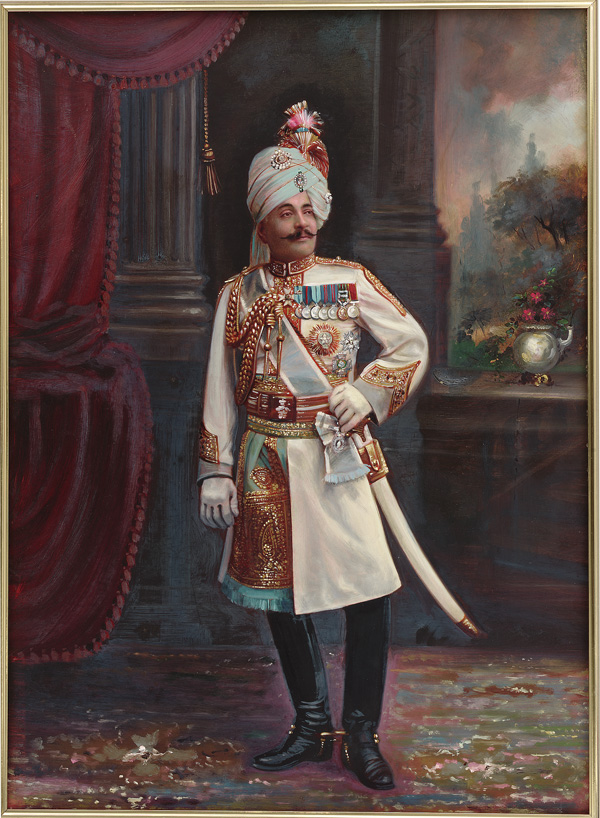
Sir Pratap Singh
Possessing the dauntless spirit of a seasoned warrior, Pratap led his elite regiment, the Jodhpur Lancers, on a gallant expedition to China in 1899, answering the call of duty to aid the British in suppressing the Boxer Rebellion. Later in life, at the remarkable age of seventy, he found himself on the battlefronts of France and Palestine, alongside his troops. In the crucible of Haifa, where heavy fighting threatened to overwhelm them, Pratap issued a succinct directive to his Lancers, imbued with unshakable resolve: "You may advance, braving the enemy's hail of bullets, or you may retreat, to face execution by my decree." The resolute Lancers, inspired by their leader's unwavering determination, chose to press on and triumphantly captured Haifa.
His standing within the realm of Jodhpur finds a parallel in the stature of another eminent regional luminary, Maharaja Ganga Singh of Bikaner. He laid the cornerstones for the edifice of the contemporary Jodhpur state, upon which Umaid Singh, who reigned from 1918 to 1947, astutely constructed. Umaid Singh's accomplishments extended beyond the realm of governance; he stood as a pioneer in the nascent field of aviation within India, even overseeing the construction of one of the nation's earliest airports. Regrettably, his son, Hanuwant Singh, possessed a fervent passion for aviation but met a tragic end in an aerial mishap at the tender age of twenty-eight.
It was through the concerted endeavors of these distinguished rulers that, following independence, Jodhpur seamlessly integrated into the Indian union. The legacy they bequeathed transcended not only the parameters of Rajasthan's most extensive dominions but also distinguished Jodhpur as one of the most modern provinces within the nascent Indian nation.